Silk Identification: How to Tell Real Silk from Fake
You ordered mulberry silk fabric. It arrived slippery, shiny, and… kind of like polyester. Now you're wondering: is this actually real silk?
Fake silk is everywhere—and it's gotten convincing. For textile buyers, sourcing managers, and brands, misidentifying silk means financial loss, quality failures, and reputational risk. This guide from Cocoonman covers 3 practical methods for silk identification, from the burn test to lab composition testing, so you can verify authenticity before you commit to a bulk order.
Need lab-verified 100% mulberry silk for your next production run? Request a sample from Cocoonman.
Why Accurate silk identification Matters for Buyers
Silk identification isn't an academic exercise. In sourcing, it directly affects margin, compliance, and brand trust.
Here's what's at stake:
- Financial risk: paying premium silk prices for polyester or rayon at scale.
- Quality control: fake silk fails in dyeing, printing, and garment construction.
- Legal exposure: mislabeled silk content can trigger customs issues and refund claims.
- Brand reputation: one fake silk batch can damage a luxury brand permanently.
- Ethical sourcing: genuine silk is tied to fair trade and sustainable supply chains.
In short, accurate silk identification protects your margin, your clients, and your supply chain integrity.
Method 1: The Burn Test
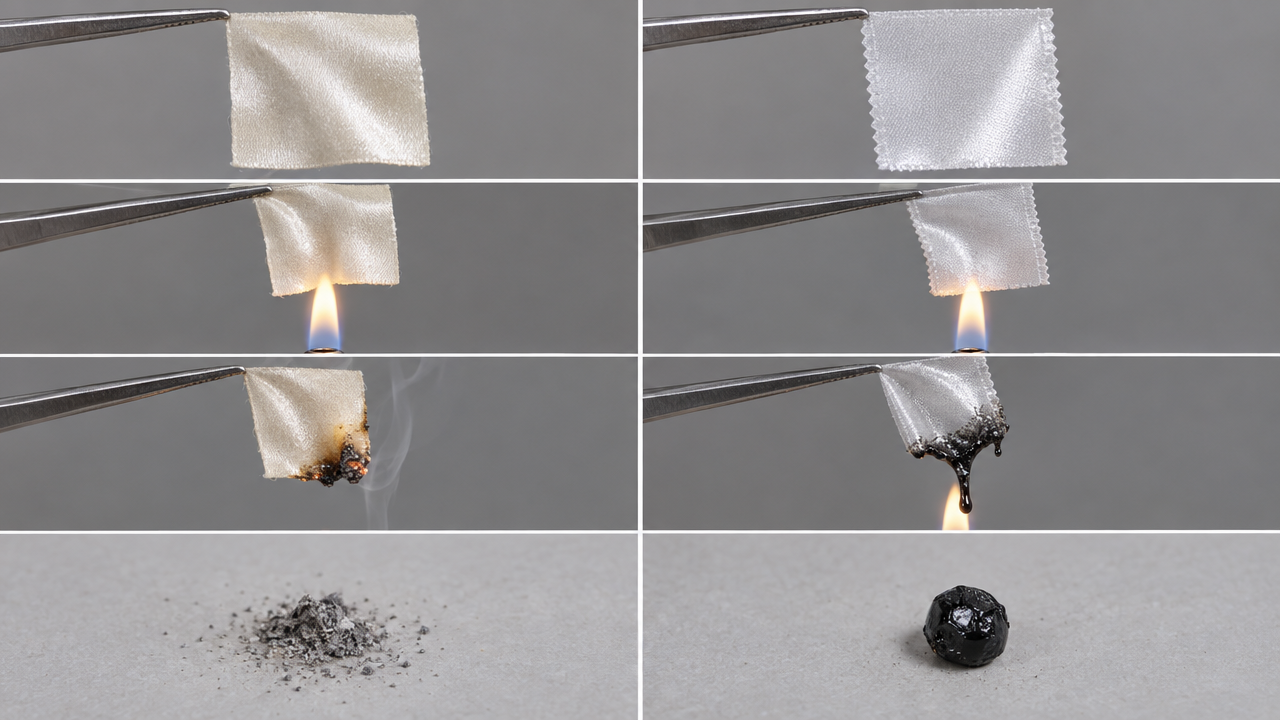
The burn test is the most direct way to confirm authenticity at home or in the office. It works because real silk is a protein fiber—just like hair.
Safety first: do this outdoors or near an open window. Hold the sample with tweezers, never your fingers, and keep away from flammable materials.
Step-by-step:
- Cut a small strand from an inside seam or selvedge.
- Hold it over a flame for 2–3 seconds.
- Pull it away and watch: does it self-extinguish?
- Smell the smoke. Crush the ash between your fingers.
Burn test results:
| Fabric | Flame Behavior | Smell | Residue |
|---|---|---|---|
| Real silk | Burns slowly, self-extinguishes | Burnt hair | Crumbles to fine ash |
| Polyester | Melts and drips | Burning plastic | Hard black bead |
| Nylon | Melts, drips | Chemical, acrid | Hard plastic residue |
| Rayon | Burns fast | Burnt paper | Soft gray ash |
Key takeaway: if it smells like burnt hair and leaves crushable ash, it's genuine silk. If it smells like plastic and leaves a hard bead, it's synthetic.
Note: the burn test damages the sample. Only use it on a hidden piece, and treat it as a quick screen—not a final verdict.
Method 2: The Bleach Soak Test
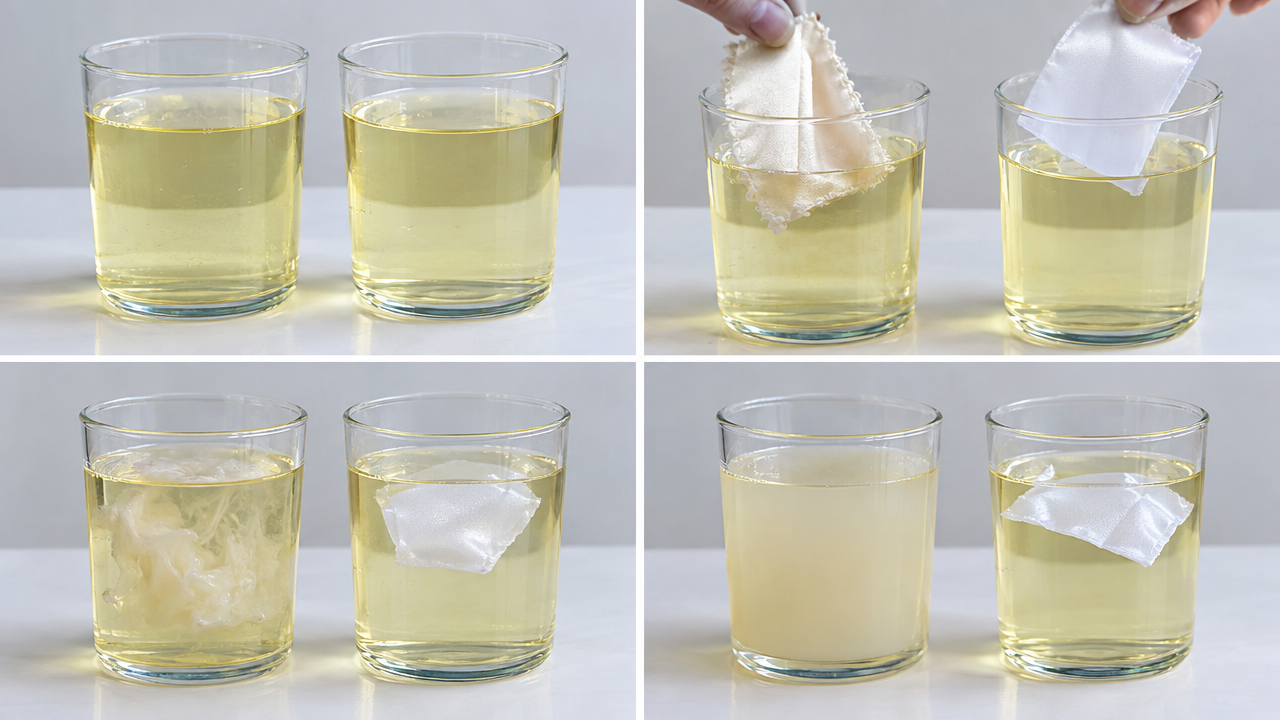
This method uses sodium hypochlorite—the active ingredient in household bleach and in the disinfectant commonly sold in China as "84 disinfectant." If your market doesn't know "84," just call it liquid chlorine bleach or sodium hypochlorite solution.
The science: silk is a protein fiber, so it dissolves in alkaline sodium hypochlorite. Polyester, nylon, and cotton do not.
What you need:
- Liquid chlorine bleach or sodium hypochlorite solution (5%–10% available chlorine works best)
- A glass cup
- A small strand of fabric or a few loose yarns
- Gloves and a ventilated space
How to do it:
- Pour a small amount of the solution into a glass cup.
- Drop in the fabric strand or yarns.
- Stir gently and wait 5–30 minutes.
- Observe: real silk dissolves into a cloudy gel; polyester and nylon stay intact.
Cautions:
- Concentration varies by product. Weak solutions may not fully dissolve silk—use a fresh, higher-concentration product for a clear result.
- Never mix chlorine bleach with acid (vinegar, toilet cleaner, rust remover). It releases toxic chlorine gas.
- Wear gloves and work in a ventilated area. Sodium hypochlorite is corrosive to skin and lungs.
- This test destroys the sample. Only test a hidden piece.
What the result means:
| Observation | Likely Fiber |
|---|---|
| Dissolves completely into a cloudy gel | Silk (protein fiber) |
| Stays intact, no change | Polyester or nylon |
| Partially dissolves or swells | Silk blend |
For buyers, this is a fast screen for supplier claims. It confirms whether silk protein is present—but it does not tell you the exact percentage.
Method 3: Lab Composition Testing
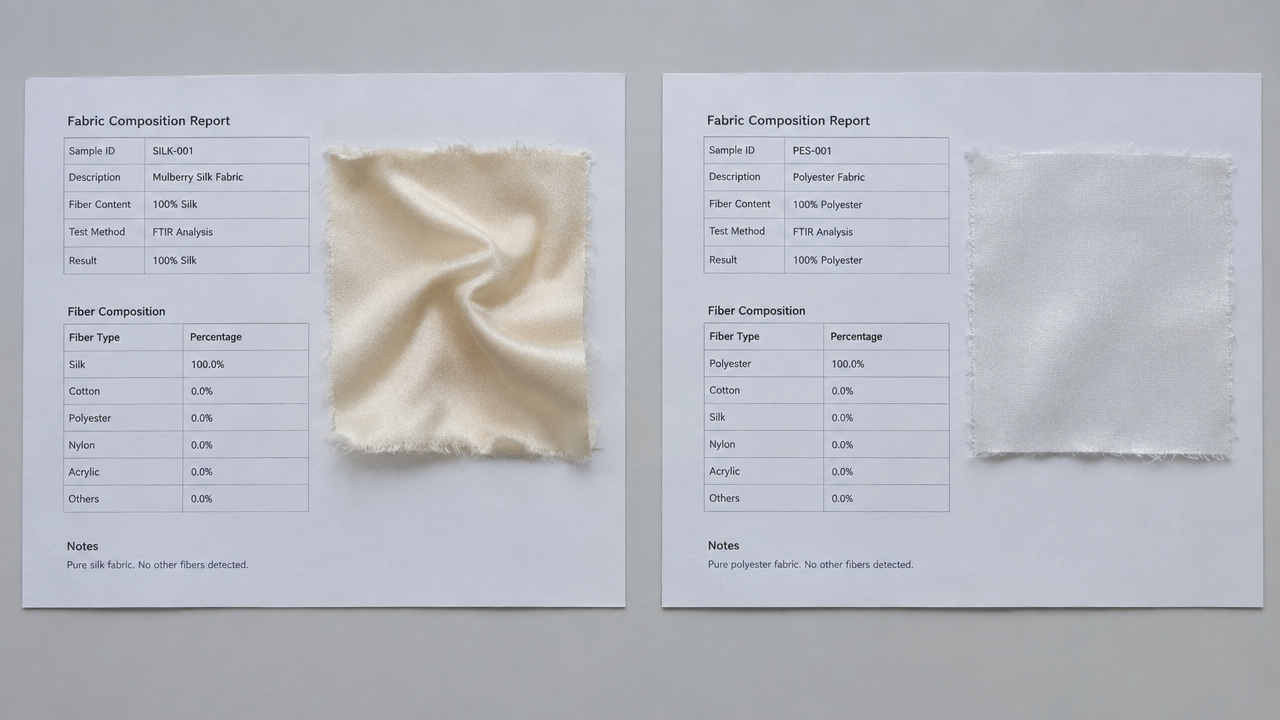
For contracts, supplier qualification, and dispute resolution, at-home methods aren't enough. A third-party lab composition test gives a quantitative result with legal validity.
The standard methods:
- GB/T 2910.4 (China) — sodium hypochlorite method
- ISO 1833-4 (international) — sodium hypochlorite method
- AATCC 20A (US) — fiber composition analysis
What a lab report tells you:
- Whether the fiber is genuine silk
- The exact silk percentage in the blend
- Whether the supplier's claim matches the actual product
Why it matters for B2B:
- The bleach test tells you whether it's silk.
- The lab test tells you how much silk is in the blend—critical for pricing, contract compliance, and customs declarations.
- A lab report is the only document that holds up in a dispute.
How to request one:
- Ask your supplier for a fiber composition report from a third-party lab.
- Verify the report references a recognized standard (GB/T 2910.4, ISO 1833-4, or AATCC 20A).
- Cross-check the report against a physical sample before committing to a bulk order.
Cocoonman provides third-party lab reports with every bulk order. Ask for a sample report.
FAQ
Q: What are the main differences between real silk and fake silk?
A: Real silk feels smooth, cool, and slightly waxy, with a natural shifting sheen. Fake silk feels warmer, stiffer, and has a flat, uniform gloss. In testing, real silk smells like burnt hair and dissolves in sodium hypochlorite; synthetics smell like plastic and stay intact.
Q: Can the burn test damage the silk?
A: Yes—it singes a small hidden sample. Cut from an inside seam or selvedge to minimize damage, and treat the burn test as a quick screen rather than a final verdict.
Q: What is "84 disinfectant," and can I use regular bleach instead?
A: "84" is a Chinese brand name for a sodium hypochlorite disinfectant. Outside China, use liquid chlorine bleach or any sodium hypochlorite solution with 5%–10% available chlorine. The active ingredient is the same.
Q: Does bleach really dissolve silk?
A: Yes. Sodium hypochlorite is alkaline and oxidizing, so it breaks down silk protein while leaving polyester and nylon intact. Weak or diluted bleach may only partially dissolve silk, so use a fresh, higher-concentration product.
Q: Is the bleach soak test as accurate as a lab test?
A: No. The bleach test is qualitative—it tells you whether silk protein is present. A lab composition test (GB/T 2910.4, ISO 1833-4, or AATCC 20A) is quantitative and tells you the exact silk percentage, which is what you need for contracts and customs.
Q: Which method should I use first?
A: Start with the burn test for a quick screen. If the result is unclear, move to the bleach soak test. For bulk orders or supplier qualification, always require a third-party lab composition report.
Q: How do I verify silk quality before placing a bulk order?
A: Ask your supplier for a fiber composition report (GB/T 2910.4 or ISO 1833-4), cross-check it against a physical sample, and run the burn test or bleach soak test yourself before committing. Or contact Cocoonman for lab-verified mulberry silk with full documentation.
Conclusion: Your 3-Step silk Check
Before you approve a supplier or place an order, run this quick checklist:
- Does it smell like burnt hair and leave crushable ash in the burn test?
- Does it dissolve in sodium hypochlorite while polyester stays intact?
- Can the supplier provide a lab composition report (GB/T 2910.4 or ISO 1833-4)?
If you answered yes to all three, you're likely working with genuine silk.
Sourcing certified 100% mulberry silk at scale? Request a sample and spec sheet from Cocoonman.
Or download our free Silk Sourcing Checklist to vet suppliers before you commit.